


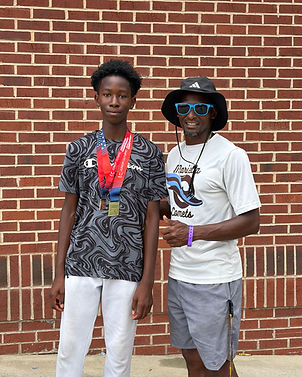

The Long Jump
The Four Phases of the Long Jump
Mastering the long jump requires more than speed and strength. Success comes from executing each phase with precision and consistency. At ATL Jump Lab, we teach athletes how to optimize every stage of the jump to maximize distance while reducing the risk of injury.
1. The Run-Up (Approach)
The approach is the foundation of a successful long jump. Its primary purpose is to build controlled horizontal speed while positioning the athlete to hit the takeoff board accurately.
A quality approach should be:
-
Consistent and repeatable
-
Progressive, accelerating from the first step to near maximum speed
-
Relaxed with efficient sprint mechanics
-
Accurate enough to consistently strike the takeoff board without stuttering or reaching
During the final few strides, athletes make subtle adjustments to prepare for takeoff while maintaining speed. A well-executed approach creates the momentum needed for a powerful jump.
Key Focus Areas:
-
Sprint mechanics
-
Acceleration and maximum velocity
-
Rhythm and stride consistency
-
Board accuracy
-
Posture and body control
2. The Takeoff
The takeoff is the most technically demanding phase of the long jump. The objective is to convert the horizontal speed generated during the approach into vertical lift while minimizing any loss of forward momentum.
A successful takeoff includes:
-
A strong, active foot plant directly beneath the body's center of mass
-
An explosive extension through the ankle, knee, and hip
-
Aggressive drive of the free knee and opposite arm
-
Maintaining tall posture and balance through the board
The goal is not to jump up as high as possible, but to create the optimal takeoff angle while preserving speed down the runway.
Key Focus Areas:
-
Penultimate and final step mechanics
-
Explosive power
-
Hip projection
-
Arm and knee drive
-
Reactive strength
-
Proper takeoff angle
3. The Flight Phase
Once the athlete leaves the ground, their center of mass follows a fixed path determined at takeoff. While athletes cannot change this trajectory in the air, they can use proper technique to maintain balance, control body rotation, and prepare for an efficient landing.
Depending on the athlete's experience level, they may use one of several flight techniques:
-
Sail
-
Hang
-
Hitch-kick (running in the air)
Each technique helps maintain body position and allows the athlete to arrive at the landing pit in the best possible posture.
Key Focus Areas:
-
Body control
-
Maintaining balance
-
Controlling forward rotation
-
Efficient arm and leg movements
-
Preparing for landing
4. The Landing
The landing is where the jump is officially measured, making it critical to maximize distance without losing inches through poor technique.
As the athlete approaches the sand:
-
The legs extend fully in front of the body.
-
The feet remain together with the toes pointed upward.
-
The arms swing forward to assist with balance.
-
Upon contact, the athlete drives the heels into the sand while allowing the hips to continue moving forward.
-
The body continues over the feet to prevent falling backward, which would shorten the measured distance.
An effective landing allows athletes to carry their momentum forward and avoid leaving marks behind their heels.
Key Focus Areas:
-
Leg extension
-
Timing
-
Heel-first contact
-
Forward momentum
-
Safe body position
-
Finishing through the landing
Every Inch Matters
The longest jumps are not simply the result of jumping harder—they're the product of executing all four phases with precision. A fast approach, explosive takeoff, controlled flight, and efficient landing work together to produce personal bests and championship performances.
At ATL Jump Lab, our coaching focuses on developing each phase through sprint training, technical instruction, strength and power development, video analysis, and event-specific drills so athletes can jump farther, compete with confidence, and reach their full potential.
Let’s Work Together
2060 Lower Roswell Rd. Ste 260
Marietta, GA 30068
E-Mail: atljumplab@gmail.com
Tel: 770-864-2412


